Luce County Dog Registration Information
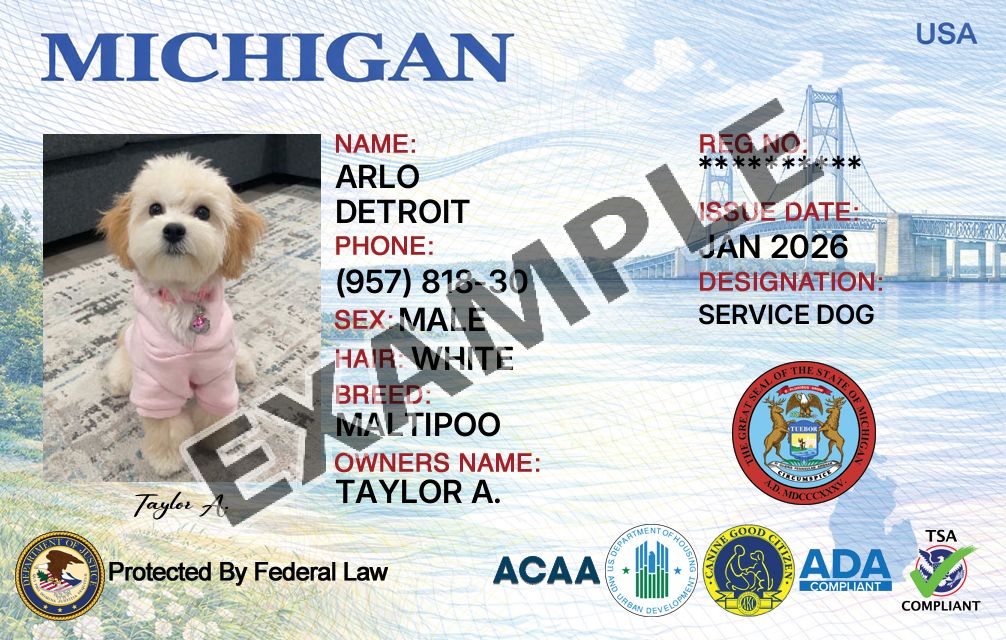
Service Dogs and Emotional Support Animals in Luce, Michigan
If you’re asking where do I register my dog in Luce County, Michigan for my service dog or emotional support dog, you’re usually looking for two different things: (1) a dog license in Luce County, Michigan (a local registration/tag tied to rabies vaccination), and (2) clarity on service dog or emotional support animal rules (which are legal classifications, not “registrations” with the county).
In Luce County, the most common “registration” residents mean is the local dog license. Licensing and enforcement are typically handled locally (county and/or local units of government), and the office you use can depend on where you live within the county. This page explains where to register a dog in Luce County, Michigan, what paperwork you may need, and how service dogs and ESAs fit into the picture.
Where to Register or License Your Dog in Luce County, Michigan
Because licensing is often handled at the county or local level, start with the offices below. These are official public offices in (or serving) Luce County that residents commonly use for dog licensing, animal control questions, shelter/stray intake, and rabies-related guidance. If an office does not directly sell licenses, it can usually tell you the correct licensing office for your address.
Official Offices (Examples)
| Office | Contact | Hours |
|---|---|---|
Luce County Treasurer (Dog Licenses)
407 W. Harrie St.
Newberry, MI 49868 |
Phone: (906) 293-8171
Email: bbridges@lucecountymi.gov
Email (Deputy): eteske@lucecountymi.gov
|
Mon–Fri 8:00 AM – 4:00 PM |
Luce County Animal Shelter
7351 County Road 391
Newberry, MI 49868 |
Phone: 906-293-6622
Email: luceshelter.lcas@gmail.com
|
Monday – Saturday, 12:00 PM – 4:00 PM (by appointment only) |
Luce County Sheriff’s Department
411 West Harrie Street
Newberry, MI 49868 |
Phone: (906) 293-8431
|
Monday – Friday 8:00 AM – 4:00 PM |
92nd District Court (Luce County)
407 W. Harrie St.
Newberry, MI 49868 |
Phone: (906) 293-5531
|
Newberry: Mon–Fri 8:00 AM – 4:00 PM (Lunch noon–1:00 PM) |
LMAS District Health Department (Serves Luce County region)
Address/hours vary by clinic location (not listed in the source for this page).
|
Phone/email not listed in the source for this page. | Hours not listed in the source for this page. |
Luce Mackinac Alger Schoolcraft Health Department (Regional example)
Schoolcraft County Courthouse, East Wing, First Floor
300 Walnut Street Manistique, MI 49854 |
Phone: 906-341-6951
|
Office hours not listed in the source for this page. |
Overview of Dog Licensing in Luce County, Michigan
What “Registering” a Dog Usually Means
In everyday conversation, “registering” a dog typically means buying a local license and receiving a tag. A dog license in Luce County, Michigan is generally a local requirement used for: identification if your dog is found, supporting rabies vaccination compliance, and helping animal control handle stray dogs, bites, and nuisance complaints. Even if your dog is highly trained or has a supportive role in your life, licensing is usually still part of responsible ownership.
Licensing Is Local (County / City / Township)
Michigan’s approach to dog licensing is largely implemented through local units of government. That means the practical “where” and “how” can vary depending on whether you live in a township, village, city, or unincorporated area. In Luce County, residents commonly begin with the County Treasurer for dog licensing questions and transactions, but you may also be directed to a local office depending on your address. When someone searches where to register a dog in Luce County, Michigan, this “local handling” is why results can feel inconsistent—different areas can point you to different counters, forms, or schedules.
Rabies Vaccination Is a Core Requirement
A current rabies vaccination is a key public health requirement in Michigan. In general, local dog licenses are issued only when rabies vaccination is up to date. Keeping rabies vaccination current protects your household, your community, and helps simplify licensing renewal and animal control interactions.
How Dog Licensing Works Locally in Luce County, Michigan
Step-by-Step: Getting a Local License Tag
- Confirm the correct licensing office for your address. Many residents can purchase licenses through the Luce County Treasurer. If you live in a jurisdiction with its own procedure, county staff can tell you where to go next.
- Get your dog’s rabies vaccination updated. Ask your veterinarian for a rabies certificate and keep a copy for your records. Most licensing counters will ask for proof.
- Bring required documentation. Requirements vary, but rabies proof and owner identification are common. Some areas may also ask for proof of residency.
- Pay the licensing fee and receive a tag. Fees and renewal cycles can vary by local ordinance. Ask for the renewal timing so you can set a reminder.
- Attach the tag to your dog’s collar. A visible tag can help animal control and shelter staff reunite you faster if your dog gets loose.
If Your Dog Is a Service Dog or ESA, Do You Still Need a License?
In most cases, yes: a service dog or emotional support animal is still a dog, and local licensing requirements usually still apply. The key difference is that licensing is about local compliance and public health (especially rabies), while service/ESA status is about legal rights and accommodations in specific settings. So if you’re searching for an animal control dog license Luce County, Michigan process for a working dog, you’re generally following the same local license steps as other residents.
What If You Just Moved to Luce County?
If you recently moved into the county with a dog, start by verifying your local jurisdiction and ask about: license deadlines after moving, whether your previous license transfers, and what proof they’ll accept (rabies certificate, ID, residency). Local offices can also tell you if your area has additional animal ordinances (for example, leash rules, kennel limits, or nuisance barking procedures).
Bites, Strays, and Enforcement Questions
If your question is driven by a bite incident, a stray dog issue, or enforcement concerns, contact the appropriate local authority for guidance. The Sheriff’s Department and local animal shelter are commonly involved in animal-related calls and can direct you to the right process for reports, quarantine guidance, or reclaim steps. For public health questions tied to rabies exposure, local or regional public health authorities may be involved.
Service Dog Laws in Luce County, Michigan
Service Dog Status Is Not a County “Registration”
A service dog is generally a dog trained to perform specific tasks for a person with a disability. Importantly, service dog status is about training and function, not a paid online registry. When residents ask where to “register” a service dog, they’re often mixing up two separate processes: (1) the local dog license, and (2) disability law protections that apply in housing, employment, and public accommodations.
Dog Licensing vs. Proof of Training
A dog license is a local government tool (rabies compliance + identification). It usually does not certify training or legal status as a service animal. You generally shouldn’t expect the licensing counter to issue a “service dog certificate.” If you need to show that your dog is a service dog, the legal standards focus on disability and trained tasks rather than a county-issued label.
Practical Tip for Residents
If you are licensing a service dog, treat it like licensing any other dog: keep rabies documentation current, maintain identification, and ask the licensing office if any local fee exemptions apply under Michigan law or local ordinance. If you’re unsure what the local office will accept, call ahead and ask what documentation is required to issue the license.
Emotional Support Animal Rules in Luce County, Michigan
An ESA Is Not the Same as a Service Dog
An emotional support animal (ESA) provides comfort that can help with symptoms of a mental or emotional condition, but ESAs are not the same as service dogs trained to perform tasks. This difference matters because the rights and access rules are not identical across settings. Many people looking up where do I register my dog in Luce County, Michigan for my service dog or emotional support dog are really trying to understand this distinction before they talk to a landlord, employer, or school.
Licensing Still Applies
In most cases, your ESA still needs a local license just like any other dog. The local licensing office’s primary focus is proof of rabies vaccination and basic owner/dog information. An ESA letter or healthcare documentation typically does not replace licensing requirements.
Housing Questions vs. Dog License Questions
If your goal is a housing accommodation, the “right office” is usually not the dog licensing counter—it’s the property manager/landlord, and the rules are tied to housing laws rather than animal control. However, having a current license tag and rabies vaccination record can still help demonstrate responsible ownership and avoid avoidable disputes.
Frequently Asked Questions
For many residents, “registering” means purchasing a local license. In Luce County, dog licenses can be purchased through the Luce County Treasurer. If you live in an area with a local process, the Treasurer or local law enforcement/animal services can direct you to the correct office for your jurisdiction.
No. A dog license in Luce County, Michigan is a local licensing/tag requirement typically tied to rabies vaccination and identification. A service dog’s legal status depends on disability law and the dog being trained to perform specific tasks—this is not something the county licensing counter “certifies.”
In general, yes. ESA status does not usually replace local animal licensing requirements. If you need an animal control dog license Luce County, Michigan for an ESA, you typically follow the standard local licensing process and provide rabies vaccination proof.
Start with the Luce County Treasurer and ask which office handles dog licensing for your exact address. Local handling is common in Michigan, so this quick check can prevent delays. If your question is enforcement-related (stray, bite, nuisance), the Sheriff’s Department or the Animal Shelter may also be able to route you to the proper authority.
A microchip can help with identification, but it typically does not replace local licensing requirements. A license tag is still an important, visible indicator for animal control and shelters, and licensing is often tied to rabies vaccination compliance.
Disclaimer
Licensing requirements and office locations may change. Residents should verify details with their local animal services office within Luce County, Michigan.
Register A Dog In Other Michigan Counties
Select your county below to get started with your dog’s ID card. Requirements and license designs may vary by county, so choose your location to see the correct options and complete your pup’s registration.
- Alcona County Dog Registration
- Alger County Dog Registration
- Allegan County Dog Registration
- Alpena County Dog Registration
- Antrim County Dog Registration
- Arenac County Dog Registration
- Baraga County Dog Registration
- Barry County Dog Registration
- Bay County Dog Registration
- Benzie County Dog Registration
- Berrien County Dog Registration
- Branch County Dog Registration
- Calhoun County Dog Registration
- Cass County Dog Registration
- Charlevoix County Dog Registration
- Cheboygan County Dog Registration
- Chippewa County Dog Registration
- Clare County Dog Registration
- Crawford County Dog Registration
- Delta County Dog Registration
- Dickinson County Dog Registration
- Eaton County Dog Registration
- Emmet County Dog Registration
- Genesee County Dog Registration
- Gladwin County Dog Registration
- Gogebic County Dog Registration
- Grand Traverse County Dog Registration
- Gratiot County Dog Registration
- Hillsdale County Dog Registration
- Houghton County Dog Registration
- Huron County Dog Registration
- Ingham County Dog Registration
- Ionia County Dog Registration
- Iosco County Dog Registration
- Irom County Dog Registration
- Isabella County Dog Registration
- Jackson County Dog Registration
- Kalamazoo County Dog Registration
- Kalkaska County Dog Registration
- Kent County Dog Registration
- Keweenaw County Dog Registration
- Lake County Dog Registration
- Lapeer County Dog Registration
- Leelanau County Dog Registration
- Lenawee County Dog Registration
- Livingston County Dog Registration
- Mackinac County Dog Registration
- Macomb County Dog Registration
- Manistee County Dog Registration
- Marquette County Dog Registration
- Mason County Dog Registration
- Mecosta County Dog Registration
- Menominee County Dog Registration
- Midland County Dog Registration
- Missaukee County Dog Registration
- Monroe County Dog Registration
- Montcalm County Dog Registration
- Montmorency County Dog Registration
- Muskegon County Dog Registration
- Newaygo County Dog Registration
- Oakland County Dog Registration
- Oceana County Dog Registration
- Ogemaw County Dog Registration
- Ontonagon County Dog Registration
- Osceola County Dog Registration
- Oscoda County Dog Registration
- Otsego County Dog Registration
- Ottawa County Dog Registration
- Presque Isle County Dog Registration
- Roscommon County Dog Registration
- Saginaw County Dog Registration
- Sanilac County Dog Registration
- Schoolcraft County Dog Registration
- Shiawassee County Dog Registration
- St. Clair County Dog Registration
- St. Joseph County Dog Registration
- Tuscola County Dog Registration
- Van Buren County Dog Registration
- Washtenaw County Dog Registration
- Wayne County Dog Registration
- Wexford County Dog Registration